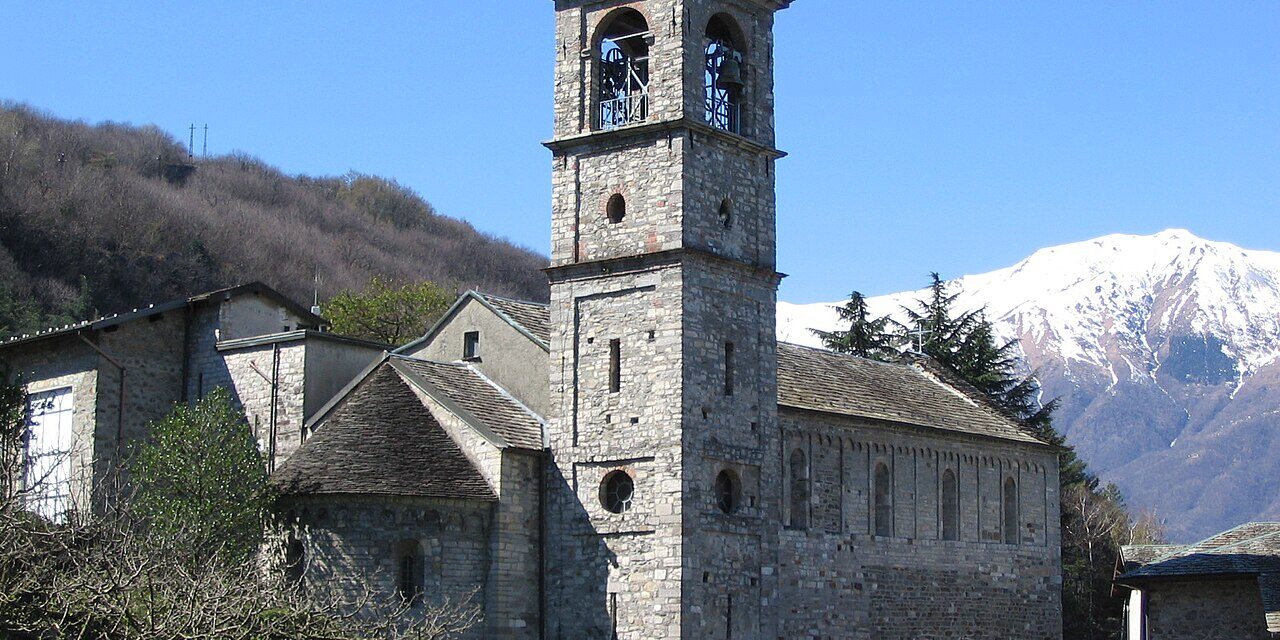
From Lecco to Piona Abbey, an itinerary along the eastern shore discovering churches, small villages and places that reveal a lesser-known side of the lake’s history.
Lake Como can also be discovered by following the outline of its bell towers. Basilicas, Romanesque churches, small places of worship and ancient monastic complexes are as much a part of the landscape as the villas, mountains and villages overlooking the water.
Along the eastern shore, they become the thread of a cultural itinerary that begins in Lecco and continues north through Mandello del Lario and Bellano, before reaching Piona Abbey. It is a journey that brings together art, history, spirituality and nature, revealing places that often remain outside the most familiar tourist routes.
Lecco: from the Basilica of San Nicolò to Pescarenico
The journey can begin in the heart of Lecco, at the Basilica of San Nicolò, one of the city’s most recognisable landmarks. Its location just a few steps from the lake and, above all, its imposing bell tower make it an unmistakable feature of Lecco’s skyline.
The city itinerary can continue with the Church of Santa Marta, in the historic centre. Smaller and more intimate than the Basilica of San Nicolò, it offers another glimpse into the city’s religious and artistic heritage and adds a lesser-known stop to a visit to Lecco.
Moving towards Pescarenico, you will find the Church of Santi Materno e Lucia, connected to the former Capuchin convent. A visit also provides the opportunity to discover one of the city’s most distinctive neighbourhoods and one of the places most closely associated with the Lecco of Alessandro Manzoni.
Mandello del Lario: San Giorgio along the Sentiero del Viandante
Continuing north, the itinerary reaches Mandello del Lario, where one of the most interesting stops lies along the historic route of the Sentiero del Viandante.
The Church of San Giorgio, set in a panoramic position above the lake, is a small building of medieval origin, particularly notable for the cycle of frescoes preserved inside. The church stands along one of the most important historic routes on the eastern shore, making it possible to combine a cultural visit with a short walk.
Here, the relationship between heritage and landscape becomes particularly evident: the church, the ancient trail, the woods and the views over the lake come together to tell part of the story of this area.
Bellano: churches and history around the Orrido
In Bellano, nature and historical heritage come together within a surprisingly compact area. A visit to the Orrido di Bellano, the spectacular natural gorge carved by the waters of the Pioverna stream, can become the starting point for discovering some of the religious buildings located nearby.
Among them is the Sanctuary of Madonna delle Lacrime in Lezzeno, overlooking Bellano from a panoramic position, while in the town centre you will find the Church of Santi Nazaro e Celso and the nearby Church of Santa Marta, two important examples of the area’s religious and artistic heritage.
In this way, Bellano becomes much more than a visit to one of Lake Como’s best-known natural attractions: in just a few hours, it is possible to combine nature, architecture, art and history, discovering a less familiar side of the village.
Piona: silence and architecture by the lake
The itinerary continues towards the Upper Lake Como area and the Olgiasca peninsula, home to Piona Abbey. The medieval monastic complex is one of the most fascinating examples of Lombard Romanesque architecture on Lake Como.
Here, the pace changes completely. The cloister, ancient capitals, stone architecture and silence create an intimate atmosphere, while nature and the lake remain a constant presence around the complex.
More than simply a visit to a church, Piona is a place where it is worth slowing down and taking your time, even if only to admire the landscape and the abbey’s unique setting.
Photo Credit: Wikipedia
An itinerary to discover a different side of the lake
From Lecco to Piona, following churches and bell towers also means passing through towns, small villages, ancient trails and very different landscapes. There is no need to fit every stop into a single day: instead, the itinerary can become a common thread for exploring the eastern shore at a slower pace.
From the urban atmosphere of Lecco to the small Church of San Giorgio along the Sentiero del Viandante, from the churches around the Orrido di Bellano to the silence of Piona Abbey, each stop reveals a different relationship between people, landscape and spirituality.
It is another way to discover Lake Como, stepping away for a while from its best-known itineraries and following the traces that history, art and faith have left along its eastern shore.